Have any question?
Text or Call (954) 573-1300

Text or Call (954) 573-1300


October is Cybersecurity Awareness Month, so there’s hardly a better time to talk about the harsh realities of devastating ransomware attacks or other business IT failures… malicious or benign. While updating passwords and enabling two-factor authentication are critical first steps, your last line of defense is always a bulletproof recovery strategy—starting with the 3-2-1-1 backup rule.

Modern cybercriminals have shifted their tactics. Instead of immediately encrypting live production servers, sophisticated attackers now quietly compromise secondary backup archives first; stripping away your ability to restore systems independently. If your enterprise data configurations allow backup logs or files to be altered or deleted, a single breach can permanently destroy your operational records and force costly, catastrophic downtime.

A main server hardware failure right before a critical business event can stop operations entirely. In a traditional reactive IT setup, a dead server means waiting days or weeks for new hardware, re-installing applications, and attempting to restore data from manual backups.
With a proactive data resilience strategy, that same hardware failure becomes a minor temporary shift rather than a business disaster.

Power failures account for 45% of all major corporate infrastructure disruptions, according to research from the Uptime Institute. This risk is highest in distributed environments like retail storefronts, logistics hubs, and satellite offices.
When a server or critical network switch loses power unexpectedly, it cannot perform a controlled shutdown sequence. That abrupt drop in power causes severe technical damage, including corrupted databases, degraded storage drives, and fried motherboard circuitry.
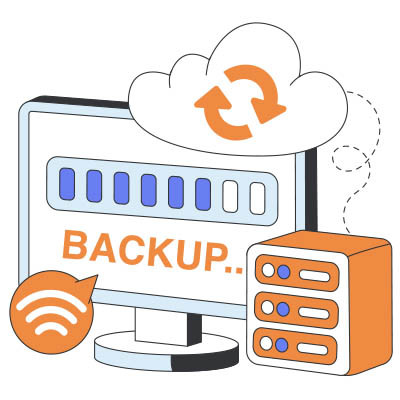
Many business owners assume their company files are completely safe until an unexpected event proves otherwise. Sudden hardware failure, accidental deletion by an employee, or a malicious cyberattack can compromise your files at any moment. Operating without a recovery plan risks everything you have built. If your files disappear tomorrow, your daily operations will halt, and recovering that lost information on your own can be nearly impossible.

Imagine walking into the office to find the file infrastructure and internal applications are inaccessible. Every directory contains a text file explaining that your data has been encrypted. This is the result of a zero-day ransomware attack that bypassed standard antivirus definitions.
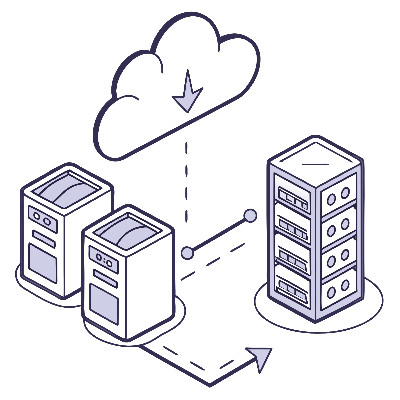
Most business owners I talk to have some form of backup. Maybe it's an external drive plugged into a server, or perhaps everything is saved in the cloud. While these are great starts, they often have a single point of failure. If your office has a fire, that external drive is gone. If a user accidentally deletes a folder and it syncs to the cloud, that data might be gone before you notice.
To make a backup "trustworthy," we use a framework called the 3-2-1-1 Rule. It sounds like a football play, but it’s actually a recipe for peace of mind.

That “checkmark” signaling a successful backup is less a guarantee of safety and more of a dangerous illusion. Many business owners might be under the impression that their data is safe simply because they got the email confirming that files have been copied to the cloud. But this is far from the truth, and you need to understand that there’s a significant difference between “having” a backup and “restoring” a backup.

We view data as our most valuable non-liquid asset. For years, the 3-2-1 backup strategy served as the industry’s fiduciary standard for data protection, a reliable safeguard against hardware failure and human error. However, the threat landscape has fundamentally shifted. Modern ransomware now specifically targets backup repositories to strip away an organization's leverage. To maintain true operational continuity in 2026, the traditional model must evolve into the 3-2-1-1 rule.

Do you know exactly how much a disaster incident could cost your business? You might think of IT as your reactive safety net, only taking action when something goes wrong or breaks, but here’s the problem… By the time your server crashes, or your office is underwater, or you’re dealing with a ransomware attack, it’s already too late.
It’s easy to think of IT as a money sink. No matter how much you spend, there’s always some issue that surfaces, requiring a considerable investment on your part. But what if we told you that you don’t have to worry about IT issues?
With the right approach, you can transition from the traditional reactive method of IT maintenance to proactive IT solutions, designed to save you money.

Building a gingerbread house is a perennial tradition in many, many households. Those with experience know that precise, careful preparation leads to a successful, long-lasting final product, while rushing and cutting corners usually leave you with a crumbling, fragile mess.
Much of the same can be said of your business’ data. This essential operational resource is terrifyingly susceptible to a litany of threats and issues that could easily bring your processes tumbling down… hence, why the 3-2-1 Backup Rule is a core element of successful business continuity.
Let’s take a moment to consider the recipe for a reliable, disaster-proof backup, and how it aligns with the process of making a gingerbread house.
Remember tape backup? For some SMBs who have moved on, this form of data backup is a clunky and frustrating relic of the past. But if you aren’t remembering it and are instead still dealing with it, you might be experiencing some operational frustrations of your own. Today, we want to cover a better solution—one that takes the unpredictability out of business continuity.

It is remarkable how much more capacity our data storage tools have than they had upon their initial invention, and how much data we’ve amassed in that time. The first-ever commercial hard drive was the size of two refrigerators, and held a mere five megabytes of data. For context, that’s about five photographs. Today, hard drives hold exponentially more data, and it is critical that you are doing everything you can to protect this data from any circumstance, from fire, severe weather, or cyberattack.
So, are you? Too many business owners aren’t sure… but there’s a way you can be.

What would you do if your entire infrastructure were impacted by ransomware all at once? Do you have a contingency in place to address this risk, or are you going to “wing it” in the face of such a threat? The smart answer is that you’ll be prepared, and a data backup and disaster recovery solution (or BDR) plan will help you do just that.

Any business can face a variety of disruptions, from natural disasters to cyberattacks. While many organizations understand the importance of preparing for the unexpected, not all of them have a solid plan in place. A well-crafted business continuity plan (BCP) is crucial for protecting your employees, customers, and bottom line.
Here are some key dos and don'ts to consider when creating your business continuity strategy.

You know your business needs data backup, but do you understand why? Simply put, your business is at risk of total annihilation if it doesn’t have a plan in place to recover lost data, and you don’t want that impending doom hanging over your head. If you’re wondering where to get started, here are three types of data that you should absolutely prioritize with your backups.
That said, you want to back up all data if you can, but these are three that we think are especially important to consider.

We need to talk about something that is as exciting as watching water boil, but it might just save your entire business one day: backing up your data.
I know, I know. You're busy doing your thing, closing deals, and you’re busy. The last thing on your mind is where your files are outside of your server. The truth is, it’s not very interesting, but it sure is important.

We’ve all felt that mini-panic that happens when our personal technology glitches. Not a great feeling. That’s just if your microwave is on the fritz, or your smartphone fell in the toilet. We all depend on multiple devices each day, but for a business owner who is responsible for so much, technology failure really isn’t an option. This month, we thought we’d go into how technology outages can impact a business to give you a better perspective of just how much is at stake.

Cyberthreats aren’t just occasional inconveniences, especially nowadays. They are constant, evolving, and some are so highly sophisticated that you can hardly blame yourself if you fall victim to them. This is why proactivity is so important. Businesses that take a reactive approach to cybersecurity find themselves in a never-ending cycle of damage control. Without a purposeful cybersecurity strategy, any organization faces recurring breaches, data loss, and ultimately a situation where customer distrust can result in the company's financial ruin. This month, we thought we would take a look at why having a comprehensive cybersecurity strategy that addresses these risks is so critical for the modern business to accomplish.
Learn more about what L7 Solutions can do for your business.
L7 Solutions
7890 Peters Road Building G102,
Plantation, Florida 33324